Where Should I Begin?
My genealogical journey began in 2019, but this blog truly starts after six years of research, mishaps, travel, and unexpected discoveries.
At first, I struggled with how to tell my story. Should I begin at the very start and try to recap everything in chronological order? Or would it make more sense to organize things by family branches and key discoveries?
A chronological approach was my original plan. However, I quickly realized it was not realistic. I do not remember everything, and in the early stages of my research, I was not as careful with documenting my findings as I should have been. Because of that, a strictly chronological retelling is not possible.
Instead, I will share my journey in no particular order. I will simply tell the stories and discoveries as I experienced them.
Starting Point: Robert Ellis Huggins
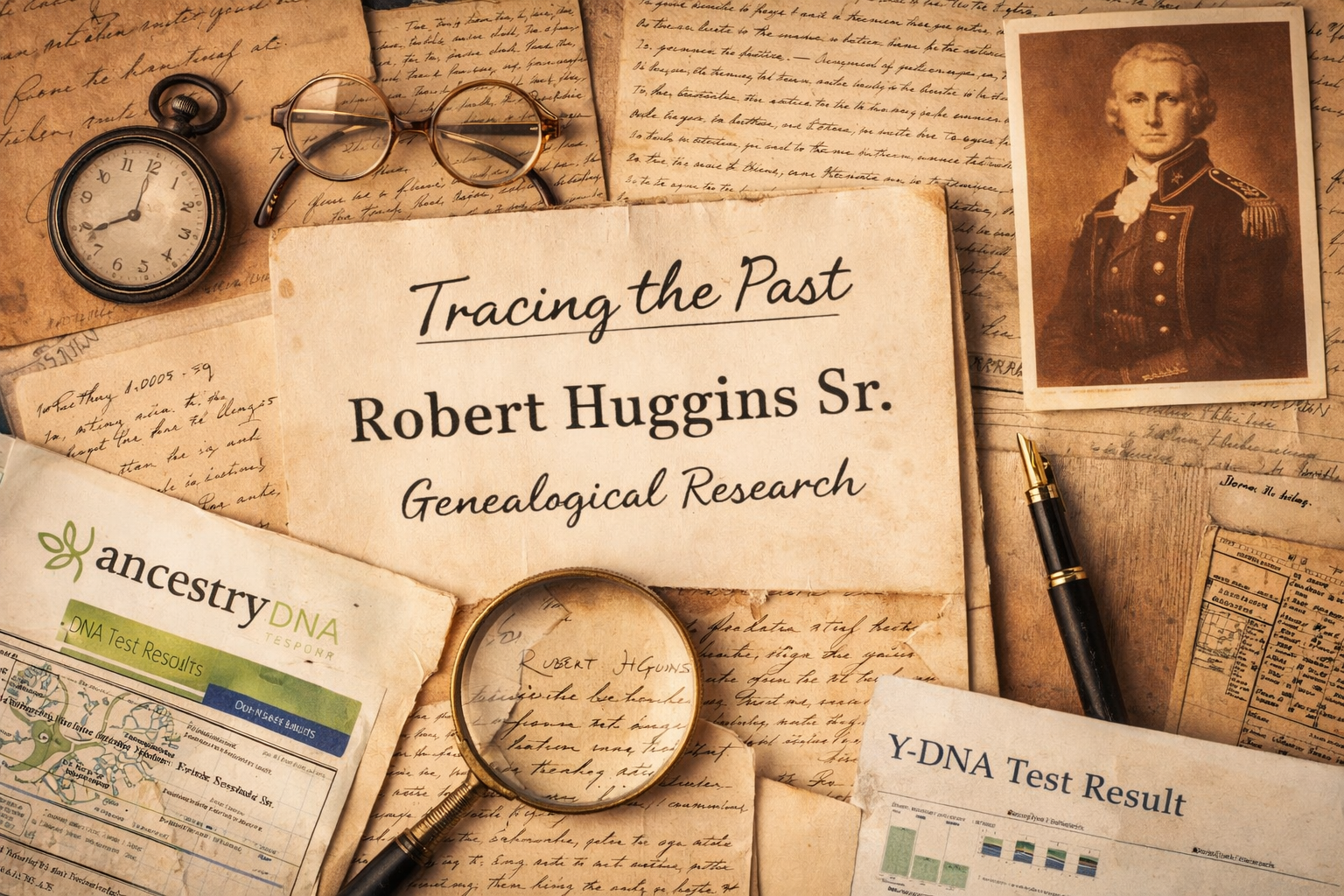
I am beginning with my third great grandfather on my mother’s side, Robert Ellis Huggins.
When I first started building my family tree, I assumed my mother’s side would be the most difficult to trace. That assumption turned out to be wrong. I have actually traced her side further back than my father’s.
There was enough documentation, along with knowledge from family members, to reach my third great grandparent without much difficulty.
The real challenge began once I reached him.
The Problem
From my records, I knew that his father was Robert Huggins. Beyond that, the information became unclear.
I had no documentation for Robert Ellis Huggins himself. I could not find a confirmed birth or death record. What I did know was limited. He had three sons, and he owned enslaved people in St. John, Red Hills.
I contacted the Jamaica Archives in search of a will, birth record, or death record. Each attempt came back with no results.
An Unexpected Gap
The lack of records was frustrating, but what puzzled me even more was my DNA research.
When I searched my matches on Ancestry, I found no one with the last name Huggins beyond my direct line. I expected to find distant relatives connected to the Huggins family, but none appeared.
The only matches with the Huggins name were direct descendants of Robert Ellis Huggins. These were the great grandchildren of his sons.
This raised an important question.
A New Question
Was Robert Ellis Huggins the last descendant of Robert Huggins Sr.?
I also considered another possibility. Perhaps Robert Huggins Sr. had no siblings. That could explain why no extended family connections were appearing in my matches.
At that point, I realized I needed a new strategy.
Shifting the Focus
If I wanted to learn more about Robert Ellis Huggins, I needed to look beyond him.
The key, I believed, was his father.
So I decided to take a deeper dive into Robert Huggins Sr.
What I Knew About Robert Huggins Sr.
Before I could learn more about Robert Ellis Huggins, I needed to focus on what I already knew about his father, Robert Huggins Sr.
From the records I gathered, Robert Huggins Sr. was a pursuer in the Royal Navy. He was married to Elizabeth Ellis, and together they had at least two sons. One son, Edward Rodon Huggins, also became a pursuer in the Royal Navy. The other was John Ellis Huggins.

Through church records, along with Monumental Inscriptions of Jamaica (United Kingdom, Society of Genealogists, 1966, p. 118), I discovered that tragedy struck the family early. John Ellis Huggins died in 1801, and shortly after, Elizabeth Ellis Huggins passed away in 1802.
Later, I confirmed that Robert Huggins Sr. died in 1824. This information came from both church records and a notice published in the Colonist and Commercial Weekly Newspaper.

Naval Records and New Clues
In addition to these findings, I located a marriage record for Robert Huggins and Elizabeth Ellis. This record revealed that he served aboard H.M.S. The Duke.
From there, I expanded my search into the UK National Archives. As a result, I uncovered additional ship records that provided more insight into his naval career and the vessels he served on.
A Faulty Assumption
At the beginning of my research, I believed that Elizabeth Ellis was the mother of Robert Ellis Huggins. This assumption seemed reasonable because of the shared name “Ellis.”
However, after reviewing timelines more carefully, that theory began to fall apart. Based on Robert Ellis Huggins’ estimated birth year, he appears to have been born after Elizabeth’s death.
Because of this, I formed another assumption. I thought that “Ellis” may have been used as a middle name in her honor. Looking back, this moment taught me an important lesson.
In genealogy, assumptions can easily lead you in the wrong direction.
Hitting a Wall
Despite these discoveries, my research eventually stalled. For a long time, I kept running into the same problem. No new records surfaced, and no clear connections appeared.
As a result, I reached a dead end in my search for more information about Robert Huggins Sr.
The Breakthrough
Everything changed when I searched his name in Google Books.
What I found next very interesting and changed the direction of my research.

It led me to Ancestry’s U.S. and Canada, Passenger and Immigration Lists Index, 1500s–1900s. From there, I discovered a record tied to a specific source:
Child Apprentices in America from Christ’s Hospital, London, 1617–1778
(Ancestry.com, 2006; originally compiled by Peter Wilson Coldham, 1990)
When I searched this database, I uncovered several key details. I learned when Robert Huggins was christened, identified his father, learned where he came from and how he ended up in Jamaica.


This was a major turning point in my research.
A Lesson in Research
What made this discovery even more significant was that the information had been available to me for quite some time. I had simply missed it.
That experience taught me an important lesson. Sometimes you need to step away, reset, and revisit sources you have already searched. A small clue can easily be overlooked the first time. Later, that same clue can break through a long-standing brick wall.
Christ’s Hospital Records
I reached out to the UK National Archives to obtain Robert Huggins’ presentation papers from Christ’s Hospital.
Christ’s Hospital was a charitable institution that provided education and trade opportunities to underprivileged children. Families had to meet certain criteria to apply. As part of the process, they submitted detailed presentation papers explaining their circumstances.
When I received Robert Huggins’ records, everything began to come together.
He was born in January 1757. He also had many siblings. His father applied to the school because he was struggling to support such a large family.
Tracing the Family Line
Knowing the family was from Reading, Berkshire, I turned to parish church records.
There, I found the names of his parents. I located several of his siblings. I was even able to find his baptismal record.
This discovery confirmed something important. The Huggins line did not end with Robert Huggins Sr. His siblings had children, and those children had families of their own. The line continued.
A New Question
That realization raised a new question. If the family line continued, why was I not seeing any of those relatives in my DNA matches?
One possible explanation is genetic dilution. As generations pass, shared DNA becomes smaller and harder to detect. This is especially true for distant relatives on platforms like Ancestry.
Even with this breakthrough, I still had not uncovered anything new about Robert Ellis Huggins.
A New Approach
At that point, I decided to try something different.
I asked my uncle, my mother’s brother, to take a Y-DNA test.
What we discovered next was quite surprising.